The History of Gramigna Pasta
Emilia-Romagna has always been a land of great flavours, one of the most important food and wine regions in our country. If we had to point out one city in particular, where these great flavours converge and come together to create incredible dishes, that would undoubtedly be Bologna. It is precisely “La Dotta” (The Learned One) that is said to have given birth to a particular pasta shape, the very one we want to talk about today: Gramigna.
THE ORIGINS
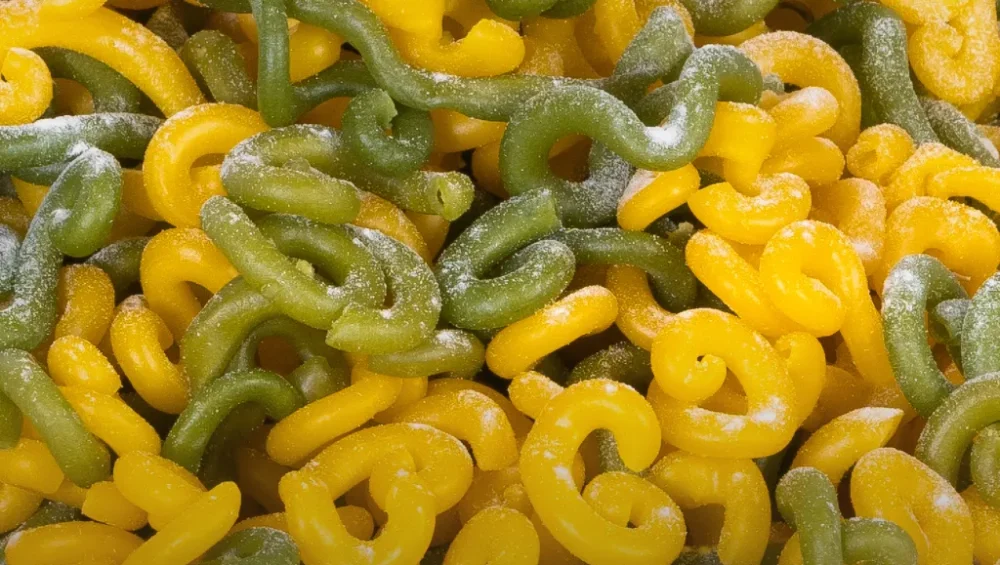
Among the great classics of Emilian cuisine, Gramigna is perhaps the one whose origins are not very well known. Since Gramigna not only appears but also plays a leading role on almost all menus in Bolognese trattorias, it is now a common opinion that Bologna is the place where it first saw the light. Another peculiarity of this dish is its name. Gramigna owes its particular name to its great resemblance to the seed of one of the most well-known grasses: it is in fact a sort of short, curled bucatini, similar to the herbaceous plant called “gramigna” (couch grass).
FRESH PASTA OR DRIED PASTA?
There has also been much debate about the original format of this type of pasta, which is also little known. We can state, with relative certainty, that Gramigna was initially born as a fresh egg pasta shape, but nowadays it is not at all strange to find it reproduced in its dried, semolina version. This change is simply due to practical reasons in the kitchen, but the first version is still the most popular one in Trattorias and Restaurants today.
HOW TO SEASON GRAMIGNA
As you surely know, each type of pasta is inextricably linked to a particular sauce, with which it pairs well and best expresses its full flavour: Tagliatelle with Bolognese Ragù, Tortelloni with Butter and Sage, Tortellini in Broth. Well, even Gramigna is not exempt from this logic, and it is indeed established that the latter is mainly served in two versions of the same sauce: Sausage. Gramigna with Sausage, as mentioned, comes in two versions:
- the “white” one, in which Butter, Parmesan, and, if needed, a splash of milk are added to the sausage
- the “red” one, which involves the addition of tomato purée, with which a sort of Bolognese Ragù based on sausage is obtained.
In short, it can be said that Gramigna is excellent paired with meat-based sauces, with which it truly expresses all its tasty potential!