The History of Parma Ham (Prosciutto Crudo di Parma)
Parma Ham is one of the greatest specialities of Emilia-Romagna. This particular type of cured ham, with its centuries-old history, has managed to clearly distinguish itself from any other thanks to its unmistakable taste and the quality of the ingredients used in its preparation. In this article, we will illustrate its history, how it is prepared, and all its delicious secrets.
Ready, set, go!
WHERE PARMA HAM ORIGINATES
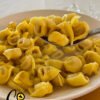
It is said that Balanzoni, also called Tortelli Matti, were born out of a desire not to waste leftovers from the dough and filling of Tortellini. Although it cannot be confirmed that this story is 100% true, the recipe for Bolognese Balanzoni, the very same one that has been handed down for generations in our Gastronomia, is indeed the original one.
The filling for Balanzoni is prepared with Ricotta, boiled Spinach, Mortadella (or pork loin), Eggs, and Parmigiano Reggiano. As for the preparation of the classic green pasta sheet, which gives colour and flavour to our Balanzoni, it requires Flour, Eggs, and Spinach. In addition to the ingredients just listed, to make everything even tastier, a pinch of nutmeg is often added, either to the filling or the dough, but omitting it is not a crime.
Traditional Balanzoni are finally served with a seasoning of Butter and Sage, capable of giving the dish a breathtaking taste.
HOW PARMA HAM IS MADE
Once we have discovered where this extraordinary ham comes from, it is essential to introduce you to what interests us most: its preparation!
Parma Ham is the result of techniques and processes that have been repeated and handed down for a very long time. To summarise, we can identify as many as 9 production phases:
- Selection
In this very first phase, the most suitable pigs for creating Parma Ham are identified. They must have very specific characteristics: Large White and Duroc breeds, originating from northern/central Italy, over 9 months old and weighing about 160 Kg.
- Cooling and trimming
After slaughter, the meat is cooled so that it stiffens enough to proceed with trimming, the process that gives the ham its unmistakable rounded shape.
- Salting
Once trimmed, the ham is ready for salting, where the rind parts are treated with wet salt, while the lean parts are sprinkled with dry salt.
- Resting
After salting, the thigh is placed for about 60-80 days in a special “resting” cell where the ham must “breathe,” avoiding becoming too damp or too dry.
- Washing and drying
After resting, the ham is rinsed with lukewarm water to remove any residual salt crystals or impurities and then dried.
- Pre-curing
At this point, the hams are hung on the traditional “scalere” (racks) and left to dry in rooms with opposite windows that are opened according to internal and external climatic conditions.
- Greasing (Sugnatura)
To soften the surface layers and prevent too rapid drying compared to the inner layers, the exposed muscle part is covered with “sugna,” a mixture of minced pork fat with a little salt, ground pepper, and sometimes rice flour.
- Curing
At the 7th month, the ham is transferred to the facility’s “cellars” to complete the curing process and allow it to develop its characteristic aroma and flavour.
- Probing and branding
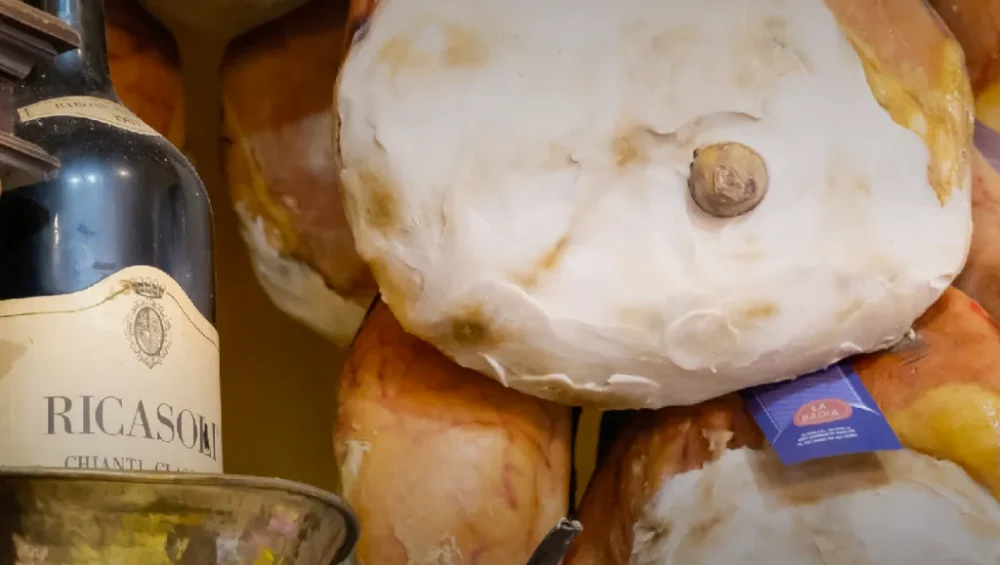
At the end of the curing process, the probing operations are carried out, where experts, through an olfactory examination, recognise and evaluate the characteristics that the ham has acquired during processing. After 12 months and all the necessary checks have been carried out, the fire brand of the “five-pointed crown” is applied, the legal certification of the Parma Ham Consortium and a guarantee of sweetness and quality.